Plaster mouldings are very fragile and become even more brittle with age, this can result in unsightly damage as definition is lost or whole sections destroyed. Good conservation practice requires that, wherever possible, surviving original work should be retained and repaired and, where necessary and appropriate, restored.
With exterior mouldings
special consideration needs to be given to the renovation of exterior cornices, columns and corbels. Colour matching and material composition are additional areas requiring a wide range of skills and knowledge to ensure that an accurate and time tested solution is chosen. If the prevention approach has not worked or has been followed at all, then conservation of the plaster mouldings must take the form of consolidation. However, before any work is carried out, moulds must be taken of any area likely to be damaged in the preservation process, including any section showing rot, mould, water damage or vandalism for example.
To make a mould, the area concerned needs to be cleaned front and back, and temporarily supported if necessary. There are a number of paste-on moulding compounds available, with adjustable setting times and hardness to help with this. A layer of the compound is applied and allowed to set. This flexible layer is then backed with plaster and a framework to ensure that the geometry of the mould is retained. The plaster back is then removed and the flexible mould peeled off. This can be used to cast a new section of fibrous plaster later for cutting into the original. |
|
Conservation of the existing fabric, assuming that the scrim is still intact, consists of ensuring that the supports and ties are intact. These will be either wire wrapped in Hessian or plaster wads, or sometimes, direct fixings to the framework.
Where the integrity of the scrim and the fibrous panel itself has been lost, it is sometimes possible to strengthen it by carefully cleaning the back of the plaster, applying a consolidant such as Primal, and sticking a reinforcing layer of hessian over the weak area with casting plaster. The design of a patch repair such as this should take into account the need to incorporate any existing timber support, and often additional support will be required - galvanise or stainless steel sections are often used to avoid any repetition of mould infestation. Wires and other fixings can be attached to the strengthened section.
Existing ties can be assisted by cleaning off failed plaster and re-wadding, or by re-attaching the ceiling end of the tie to its support.
Where large sections of original plaster work have been lost or cannot be repaired, glass reinforced gypsum is often used as a substitute for the original material, chiefly because glass fibre is not affected by decay to the extent that hessian is. |
|
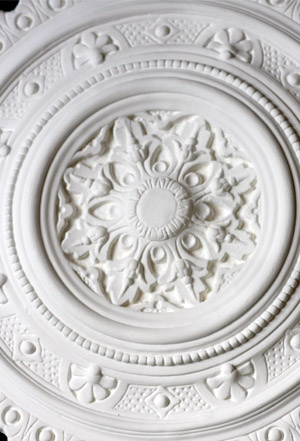
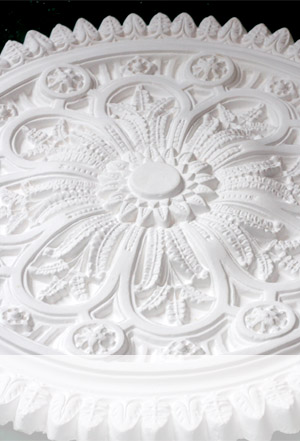
| Fill the void on your ceiling with beautiful ceiling roses |
|